
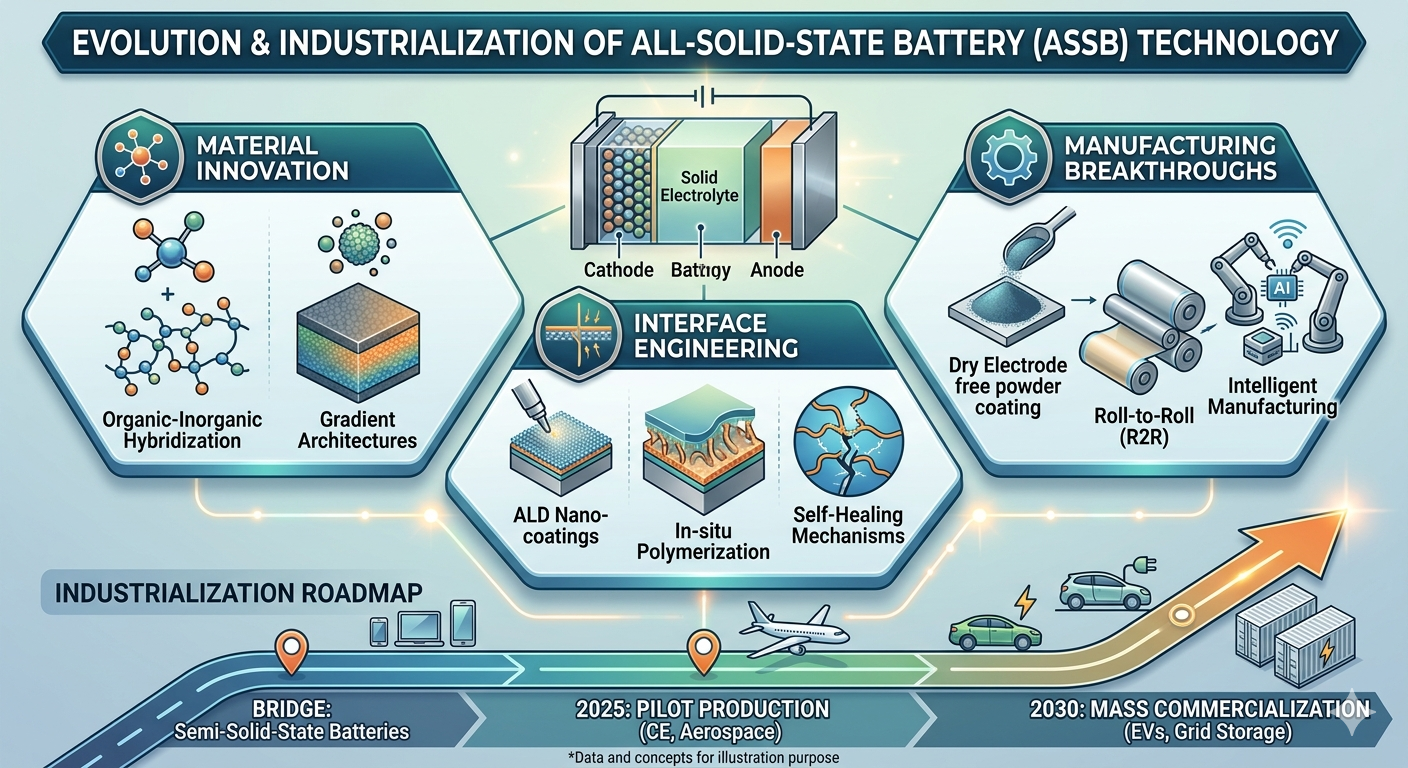
As the vanguard of next-generation energy storage, All-Solid-State Batteries (ASSBs) are evolving along three synchronized fronts: material innovation, interface engineering, and manufacturing breakthroughs. The industry is currently traversing the critical “valley of death” between laboratory proof-of-concept and large-scale industrial integration.
1. Material Technology: From Singular to Synergistic
The electrolyte landscape has shifted from monolithic materials to sophisticated composite systems. Early research struggled to find a single material that could simultaneously deliver high ionic conductivity, interfacial stability, and mechanical resilience.
- Organic-Inorganic Hybridization: Current R&D prioritizes composite electrolytes that marry the flexibility of polymers with the high conductivity of ceramics.
- Gradient Architectures: The latest frontier involves gradient-structured electrolytes, which tailor material properties across the cell to optimize performance matching at both the anode and cathode.
2. Interface Engineering: Solving the Solid-Solid Contact
The transition from liquid to solid electrolytes introduced significant impedance challenges. Innovative solutions are now bridging this gap:
- Atomic Layer Deposition (ALD): Used to apply nanoscale transition layers that suppress side reactions and reduce interface resistance.
- In-situ Polymerization: This technique creates a “conformal” flexible layer that maintains contact even as electrodes expand and contract during cycling.
- Self-Healing Mechanisms: Incorporating dynamic polymers allows the interface to “repair” micro-cracks autonomously, significantly boosting cycle life.
3. Manufacturing Evolution: The Shift to “Dry” and “Continuous”
To compete with traditional lithium-ion batteries, ASSB production is moving away from inefficient batch processing toward high-throughput, continuous lines.
| Technology | Impact on Production |
| Dry Electrode Process | Eliminates toxic solvents, reduces energy footprint, and lowers equipment costs. |
| Roll-to-Roll (R2R) | Enables high-speed, continuous fabrication of ultra-thin electrolyte membranes. |
| Intelligent Manufacturing | Leverages AI and real-time sensing to ensure micron-level precision and batch-to-batch consistency. |
4. The Industrialization Roadmap
The path to market follows a “staircase” model of maturity, utilizing semi-solid-state batteries as a vital bridge to gain engineering data and consumer trust.
- 2025 – The Inflection Point: Expect to see the first wave of small-scale pilot production, primarily targeting premium consumer electronics and specialized aerospace applications.
- 2030 – Mass Commercialization: As costs scale down, ASSBs will begin penetrating the New Energy Vehicle (NEV) and grid-scale energy storage markets.
Final Outlook: With the convergence of dry-process manufacturing and stable interface chemistry, All-Solid-State Batteries are poised to redefine the energy landscape, offering a safer, higher-density alternative to the liquid-electrolyte status quo.