
In modern semiconductor fabrication—particularly next-generation wafer processing, advanced substrate packaging, and halide perovskite lithography—the margin for environmental error has non-linearly narrowed. While standard industrial or pharmaceutical gloveboxes manage microenvironments at parts-per-million ($ppm$) levels, semiconductor-grade fabrication demands continuous sub-part-per-billion ($ppb$) purity, precise electrostatic dissipation, and absolute molecular contamination control. At this threshold, containment is no longer […]
Industry Solutions
7 Common Misconceptions in Trace Gas Detection for Glovebox Applications
In high-purity microenvironments—such as lithium-metal battery R&D, halide perovskite thin-film deposition, and organic electronics encapsulation—achieving sub-part-per-million ($ppm$) or sub-part-per-billion ($ppb$) levels of oxygen ($O_2$) and moisture ($H_2O$) is a baseline operational requirement. However, maintaining this purity relies entirely on the mathematical and physical accuracy of trace gas analytical feedback loops. In industrial field operations, technical […]
4 Engineering Techniques to Identify Gas Sampling Errors in Glovebox Applications
Achieving and verifying sub-part-per-million ($ppm$) or sub-part-per-billion ($ppb$) oxygen ($O_2$) and moisture ($H_2O$) levels in controlled-atmosphere gloveboxes requires more than high-performance analyzers. It requires a flawless sample delivery loop. In industries like lithium-metal battery assembly, advanced organic electronics, and semiconductor fabrication, process engineers frequently encounter a frustrating paradox: the primary loop analyzer displays pristine, stable […]
6 Engineering Best Practices for Calibrating Trace Gas Sensors in Glovebox Applications
Maintaining ultra-high purity atmospheres—where oxygen ($\text{O}_2$) and moisture ($\text{H}_2\text{O}$) counts must consistently remain below 1 part per million ($\text{ppm}$) or even deep into the parts-per-billion ($\text{ppb}$) regime—is a fundamental requirement for advanced battery R&D, perovskite electronics, and semiconductor fabrication. However, the integrity of a controlled-atmosphere glovebox is completely bound to the analytical precision of its […]
8 Critical Engineering Factors Impacting Gas Detection Accuracy in Glovebox Application以
In modern controlled-atmosphere glovebox applications—ranging from lithium-metal battery fabrication and perovskite solar cell research to advanced semiconductor packaging—maintaining sub-part-per-million (ppmppm) or sub-part-per-billion (ppbppb) levels of oxygen (O2\text{O}_2) and moisture (H2O\text{H}_2\text{O}) is paramount. However, achieving process success depends entirely on the analytical precision of your gas sensors. In industrial field operations, technical teams frequently face a […]
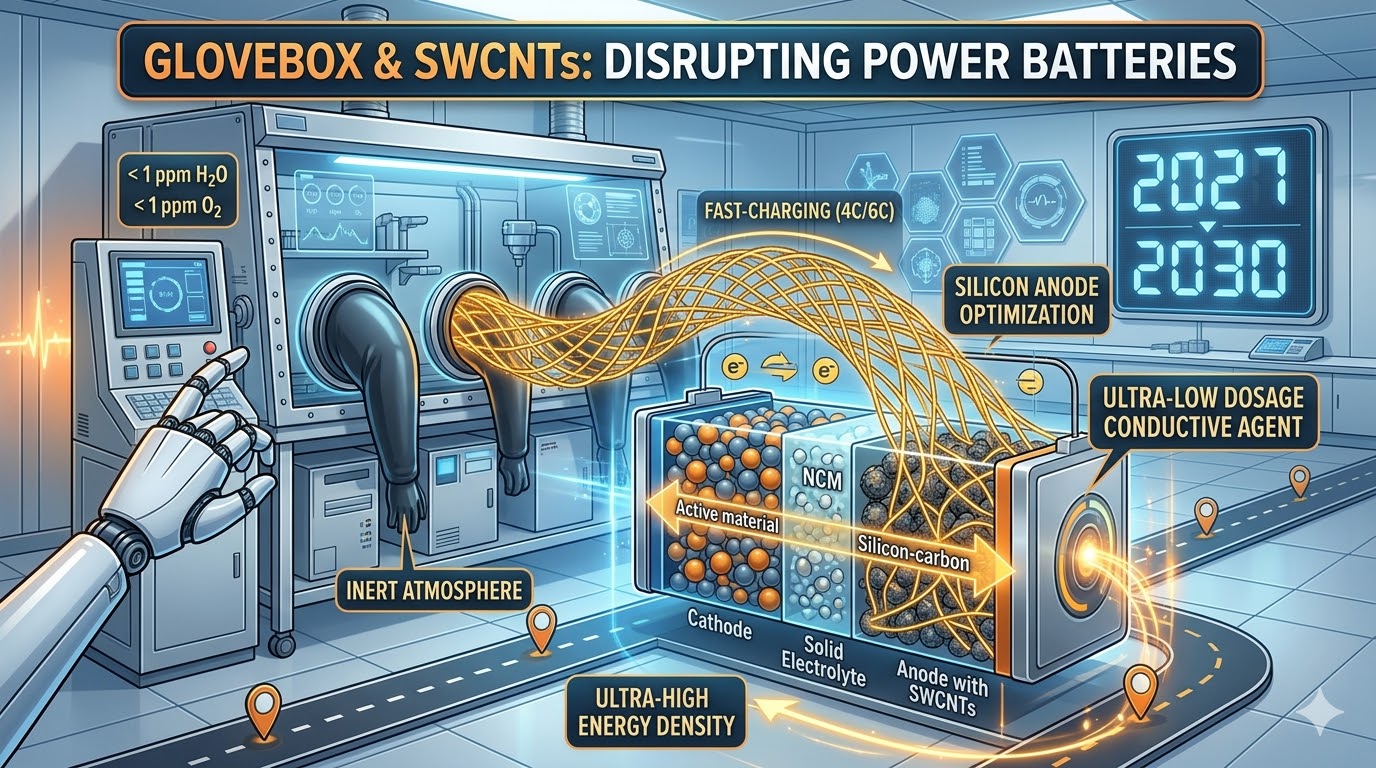
Glovebox & SWCNTs: Disrupting the Conductive Landscape of Power Batteries
Introduction The quest for higher energy density and faster charging in the EV industry has led to a critical realization: active materials alone aren’t enough. The “connective tissue” of the battery—the conductive additive—is undergoing a radical transformation. Single-Walled Carbon Nanotubes (SWCNTs) have emerged as the ultimate disruptor. However, to harness their potential without compromising purity […]
Humanoid Robot Power Revolution: Empowering All-Solid-State Batteries and Glovebox Optimization
Introduction Humanoid robots are on the threshold of transitioning from research laboratories to the mass consumer market. However, three persistent mountains—range, weight, and safety—remain the critical bottlenecks hindering their commercialization and widespread adoption. The limitations of traditional liquid lithium-ion batteries have caused the industry to pivot towards All-Solid-State Batteries (ASSBs). This is a revolution in […]
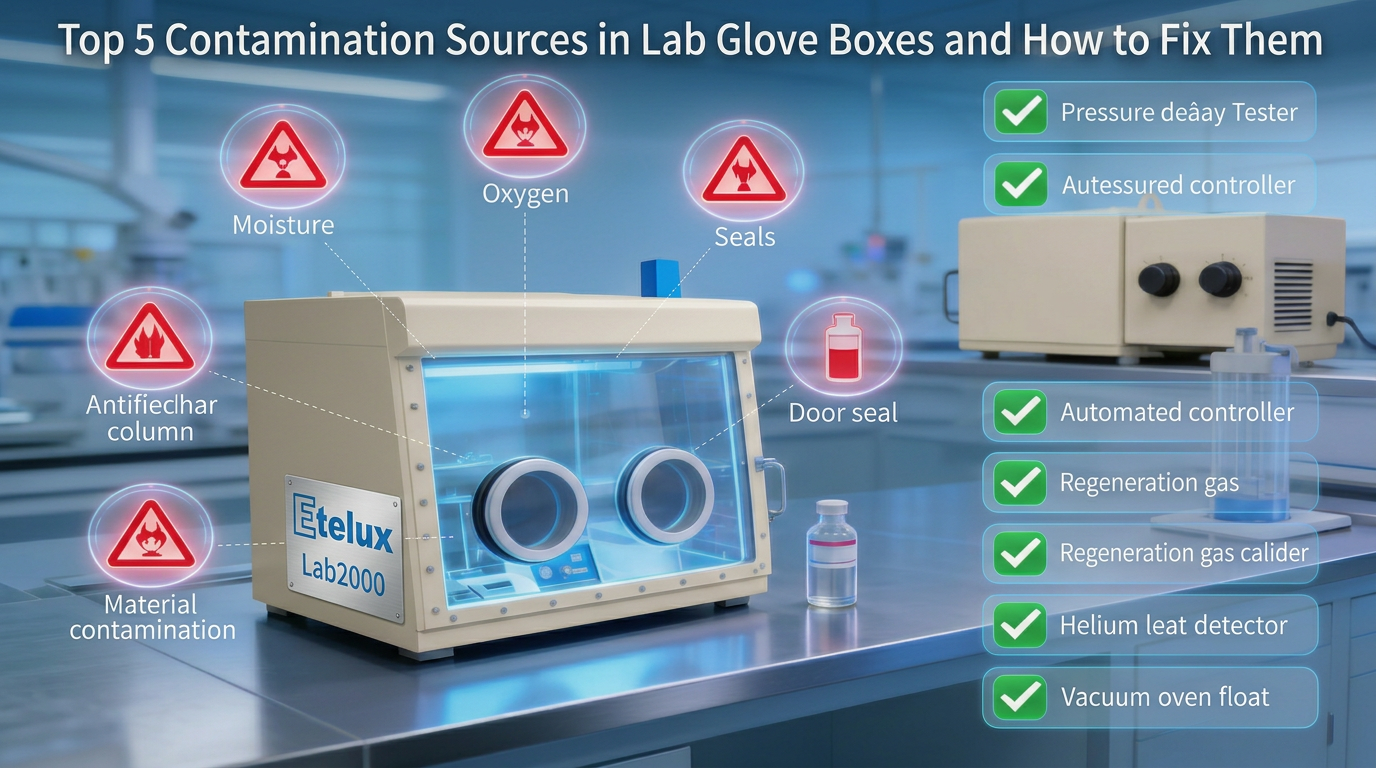
Top 5 Contamination Sources in Lab Glove Boxes and How to Fix Them
In the precision-driven world of laboratory research and pharmaceutical manufacturing, the glove box serves as the final line of defense against atmospheric contamination. However, by 2026, shifting global logistics and rising operational costs have introduced new variables into how these enclosures are maintained. Maintaining an inert atmosphere requires more than high-quality hardware—it demands a rigorous, […]