Introduction
The quest for higher energy density and faster charging in the EV industry has led to a critical realization: active materials alone aren’t enough. The “connective tissue” of the battery—the conductive additive—is undergoing a radical transformation. Single-Walled Carbon Nanotubes (SWCNTs) have emerged as the ultimate disruptor. However, to harness their potential without compromising purity or structural integrity, a highly optimized manufacturing environment—specifically advanced Glovebox systems—is becoming the silent enabler of this revolution.
I. The SWCNT Edge: Why It’s a Game Changer
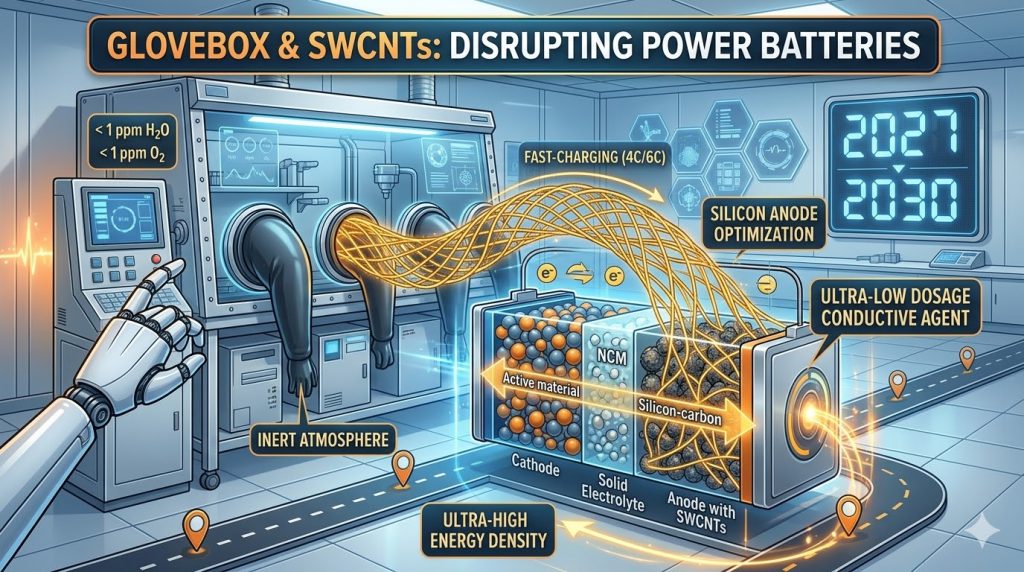
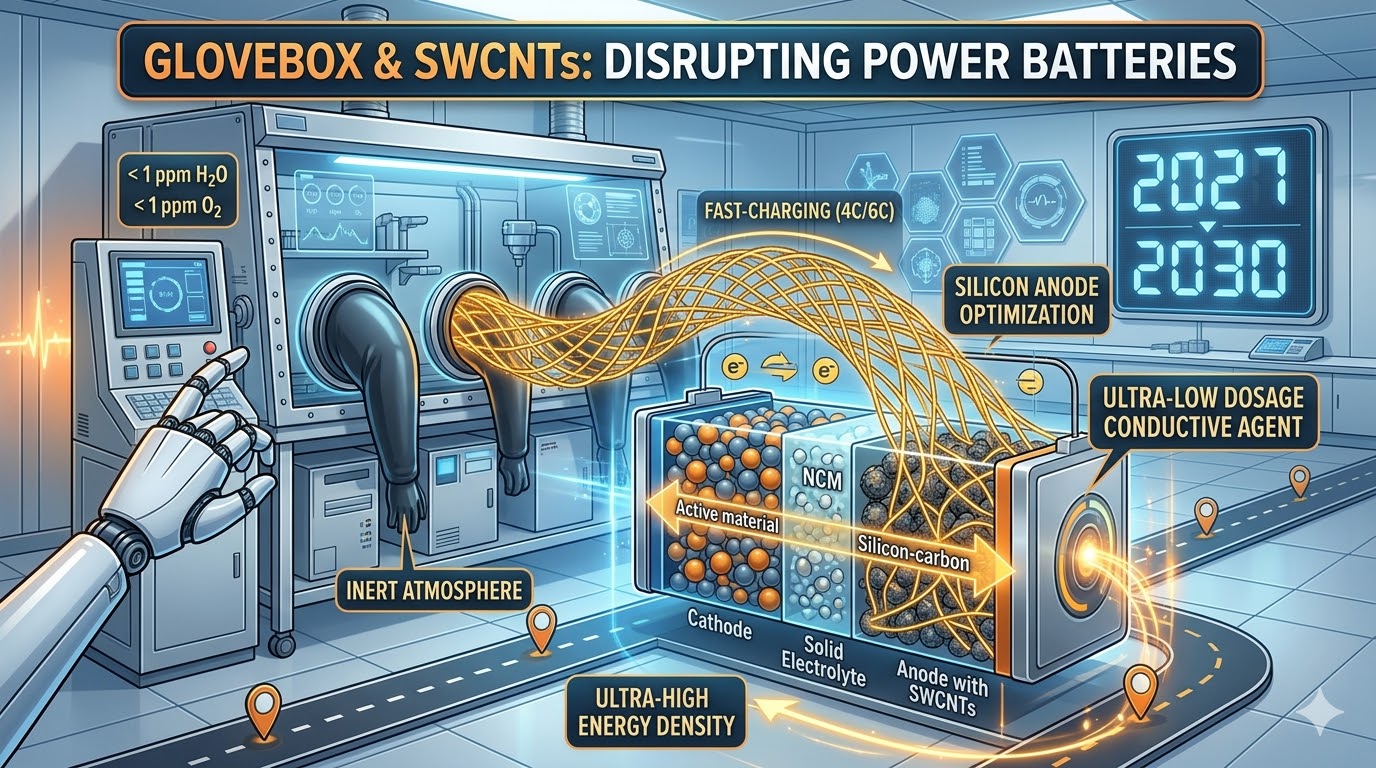
Traditional conductive agents like Carbon Black or Multi-Walled Carbon Nanotubes (MWCNTs) are reaching their limits. SWCNTs offer a “1D” ultra-high aspect ratio that creates a robust conductive network at dosages 10–50 times lower than traditional materials.
- Ultra-Low Dosage, High Active Material Ratio: Because SWCNTs are so efficient, they occupy less volume in the electrode, allowing for a higher percentage of active materials (NCM, LFP, or Silicon-carbon), directly boosting energy density.
- Flexible Conductive Bridges: During the expansion and contraction of silicon-based anodes, SWCNTs act as flexible “nanowires” that maintain electrical contact, significantly extending cycle life.
- Superior Rate Performance: The high intrinsic conductivity of SWCNTs facilitates rapid electron transport, enabling the “4C” or even “6C” fast-charging capabilities required by the next generation of EVs.
II. The Humidity & Oxygen Challenge: Why Gloveboxes Matter
While SWCNTs are powerful, they are incredibly sensitive to their environment during the slurry preparation and electrode coating stages. This is where optimized Glovebox technology becomes indispensable.
- Moisture Sensitivity (< 1 ppm H2O): Even trace amounts of water can cause SWCNTs to re-agglomerate or react with advanced electrolytes (especially in solid-state or high-nickel systems), leading to “dead zones” in the battery.
- Oxygen Control (< 1 ppm O2): For high-performance silicon-carbon anodes or lithium-metal interfaces paired with SWCNTs, oxygen exposure triggers surface oxidation, increasing internal resistance.
- Handling Ultra-Fine Powders: SWCNTs are exceptionally light and prone to dusting. Optimized gloveboxes provide a closed-loop system that prevents cross-contamination and ensures the safety of technicians.
III. Integrated Optimization: The “Glovebox + SWCNT” Synergy
To maximize the “Disruptor” effect of SWCNTs, manufacturing lines are integrating specific optimizations:
1. Dispersion Control in Controlled Atmospheres
The biggest hurdle for SWCNTs is dispersion. In an optimized glovebox, the viscosity and stability of the SWCNT-laden slurry can be maintained under a constant inert gas (Argon/Nitrogen) environment. This prevents the solvent from absorbing moisture, which is the primary cause of poor dispersion and “clumping.”
2. In-situ Interface Monitoring
Advanced gloveboxes now feature integrated spectroscopic tools. This allows researchers to monitor the interaction between SWCNTs and the electrode surface in real-time, ensuring that the conductive “nanonetwork” is forming correctly without being hindered by environmental impurities.
3. Scaling Up: From Lab to Pilot Line
The industry is moving from small research gloveboxes to Large-Scale Integrated Glovebox Suites. These systems house R2R (Roll-to-Roll) coaters and high-shear mixers within a continuous, ultra-pure environment, ensuring that the high-performance benefits of SWCNTs seen in the lab are successfully replicated in mass production.
IV. Roadmap: The Future of Conductive Systems
As we look toward 2027-2030, the synergy between SWCNTs and environmental control will follow this trajectory:
- Phase 1 (Current): SWCNTs used as a “booster” for silicon anodes, processed in standard glovebox environments.
- Phase 2 (2026+): SWCNTs become the primary conductive agent. Glovebox lines integrate AI to monitor water-oxygen levels and adjust mixing speeds automatically.
- Phase 3 (2030): Total integration. Solid-state batteries utilize SWCNTs for 3D conductivity, manufactured entirely within “Glovebox-Industrial” mega-factories to ensure zero-defect production.
Conclusion
Single-Walled Carbon Nanotubes are undoubtedly the disruptors of the battery world, providing the “nerves” for the power cells of tomorrow. But like any high-performance material, they require a perfect environment to thrive. Glovebox optimization isn’t just a safety measure; it is the fundamental infrastructure that allows SWCNTs to redefine the limits of power, safety, and energy density in the era of electric mobility.