
Introduction Modern glovebox systems rely heavily on PLC (Programmable Logic Controller) systems to coordinate gas circulation, valve switching, safety protection, and regeneration cycles. Unlike simple automation tasks, glovebox PLC systems must manage multi-layer real-time environmental control logic. 1. Role of PLC in Glovebox Systems The PLC is responsible for: It acts as the central decision-making […]
Technical Insights
Glovebox Purification Column Regeneration: Multi-Stage Process and System Efficiency Impact
Introduction Purification columns are responsible for maintaining ultra-low oxygen and moisture levels in glovebox systems. Over time, adsorption materials become saturated and require regeneration. This process is critical to long-term system stability and directly determines how long a glovebox can maintain low ppm-level performance. 1. Structure of Purification Columns Most glovebox purification systems include two […]
When Sensors Lie: Cross-Interference and Calibration Strategies in Trace Gas Detection
The Disconnect in the Field The glovebox display reads 0.5 ppm O20.5\text{ ppm O}_2 and . On paper, the environment is pristine. Yet, the lithium metal sample turns black by morning. Or the perovskite precursor degrades, or the air-sensitive catalyst undergoes uncharacteristic passivation. The control panel reports absolute containment; the physical samples show outright failure. This behavior […]
Dew Point Control and Moisture Management Systems in Solid-State Battery Manufacturing Lines
Focus: Molecular Sieve Regeneration, Electrode Moisture Prevention, and Continuous Glovebox–Automated Line Integration Keywords: solid-state battery, dry room, dew point control, molecular sieve, electrode drying, glovebox integration, automated manufacturing, moisture management Abstract Solid-state batteries (SSBs) impose significantly stricter environmental controls than conventional lithium-ion cells. Sulfide-based solid electrolytes react with atmospheric moisture at concentrations as low as […]
From Aluminum Sheet Oxidation to Wafer Fabrication: The Advanced Path of PPB-Grade Moisture and Oxygen Control Technology
In modern industrial processing, maintaining an inert atmosphere is essential to preventing material degradation. However, the definition of “inert” shifts dramatically depending on the application. For standard metallurgy—such as preventing surface discoloration on heated aluminum sheets—parts-per-million (ppm) control of moisture (H2OH_2O) and oxygen (O2O_2) is entirely sufficient. But when we move into advanced semiconductor manufacturing—specifically within […]
Design of High-Temperature Furnaces for Simulating Mantle Environments: Extreme High-Pressure and High-Temperature (HPHT) Technologies in Magma Experiments
In the intersection of deep space exploration and geosciences, laboratory simulation of “extreme environments” serves as a core methodology for scientists to decipher planetary internal evolution, mantle rheology, and extraterrestrial geological structures. Simulating a mantle environment demands more than just precise temperature control and strict inert atmosphere protection; it requires the integration of giga-pascal (GPa-grade) […]
Digital Twin in Non-Standard Custom Furnaces: Eliminating Design Flaws Upstream via Thermal Simulation
Here’s your polished, error-checked version, optimized for an independent site push notification. I’ve corrected minor grammatical issues, improved readability, and made the tone slightly more engaging while keeping the technical depth intact. Digital Twin in Non-Standard Custom Furnaces: Eliminating Design Flaws Upstream via Thermal Simulation In advanced material synthesis, semiconductor processing, and specialized thermal engineering, […]
Corrosion Mechanisms and Protective Technologies for Furnace Linings Under Chlorine/Fluorine-Containing Atmospheres
In modern high-temperature reaction processes—such as fine chemical processing, hazardous waste incineration, precious metal refining, and semiconductor raw material smelting (e.g., silicon tetrachloride and nitrogen trifluoride production)—the generation of high concentrations of halogen gases (e.g., Cl2,HCl,F2\text{Cl}_2, \text{HCl}, \text{F}_2, HF\text{HF}) within the system is often unavoidable. At elevated temperatures ranging from 800∘C800^\circ\text{C} to 1500∘C1500^\circ\text{C}, these highly […]
Heating Systems and Element Technology
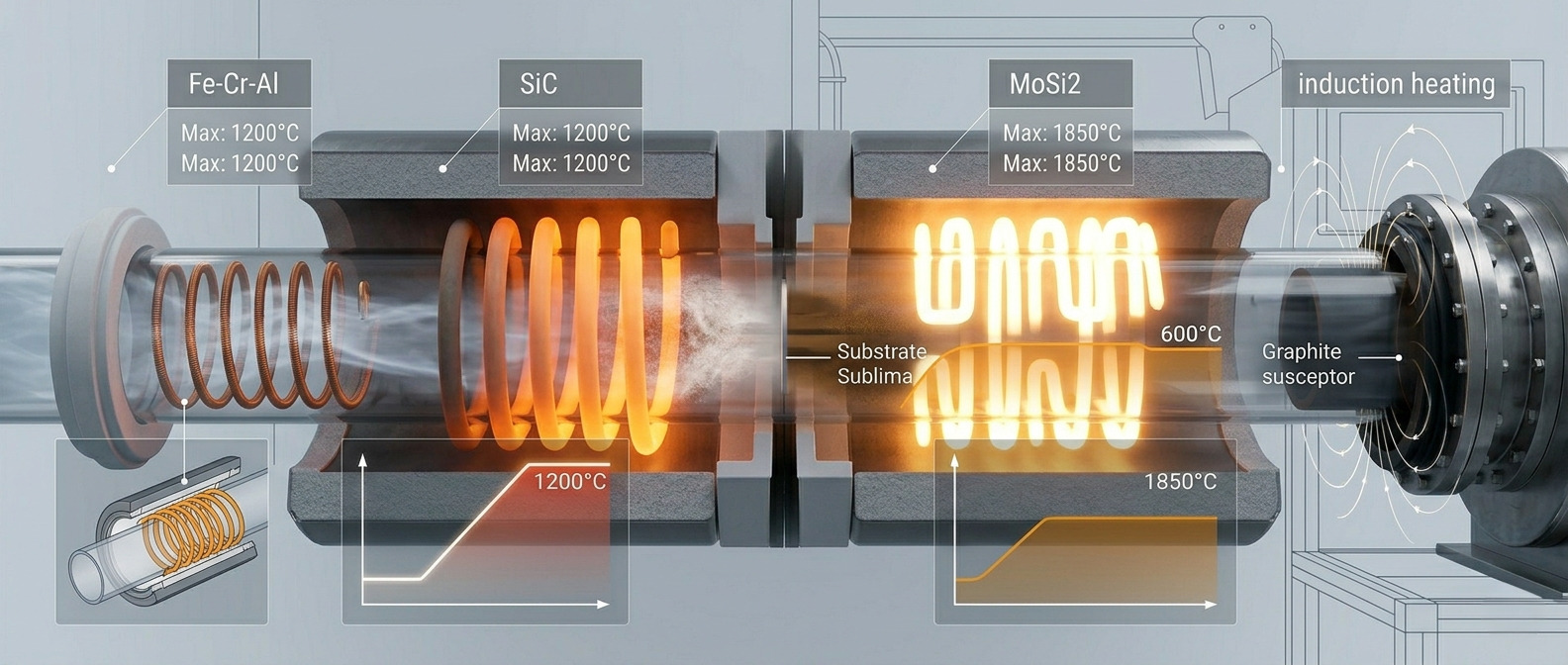
The heating system converts electrical energy into thermal energy and determines the maximum operating temperature and longevity of the furnace. Heating Element Categories Heating Geometry and Uniformity To ensure a large “constant temperature zone,” heating elements are often densely coiled at the ends of the furnace and sparsely placed in the center. This compensates for […]
Integration Technology: Connecting Vacuum Tube Furnaces with Glove Boxes
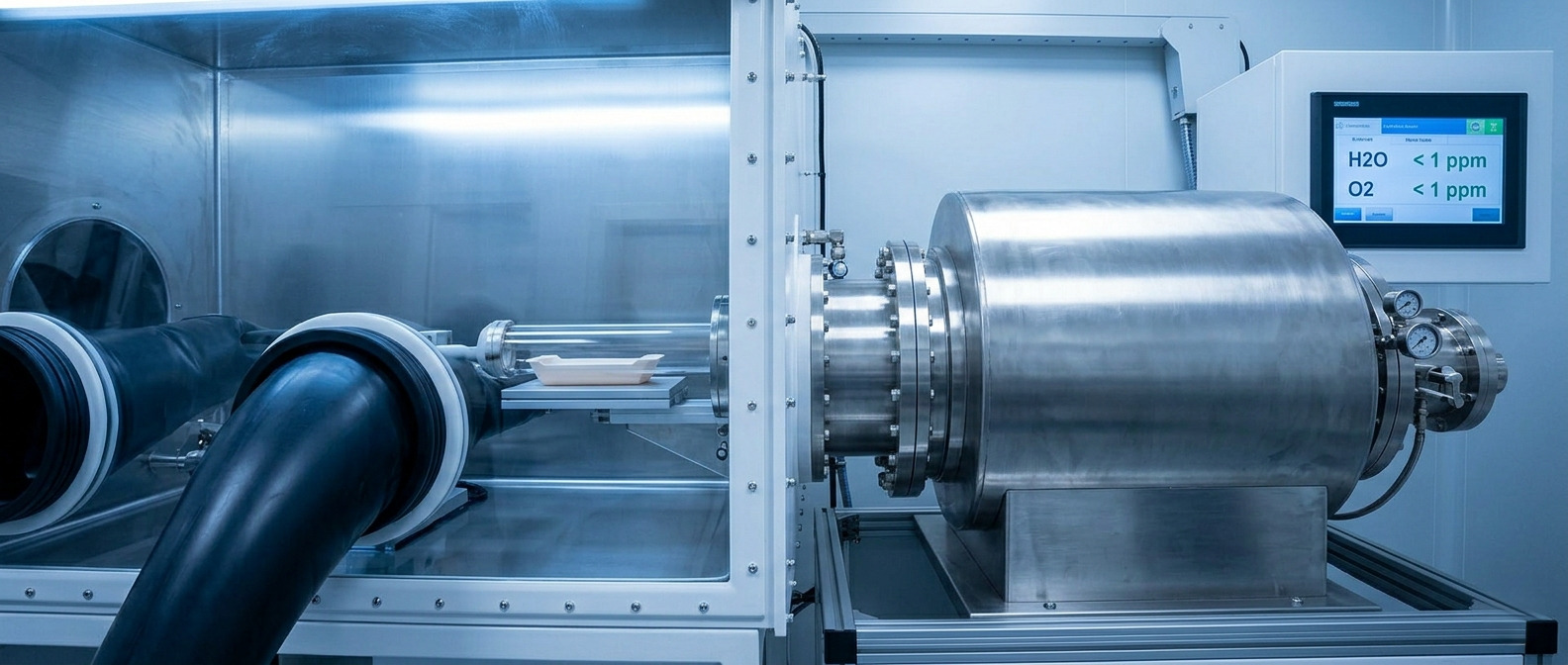
The integration of a vacuum tube furnace with an inert atmosphere glove box is a sophisticated engineering solution designed for the synthesis and processing of materials that are sensitive to oxygen or moisture, such as lithium-ion battery electrodes, perovskite solar cells, or reactive rare-earth alloys. System Architecture The connection is primarily achieved through a side-mounted […]