
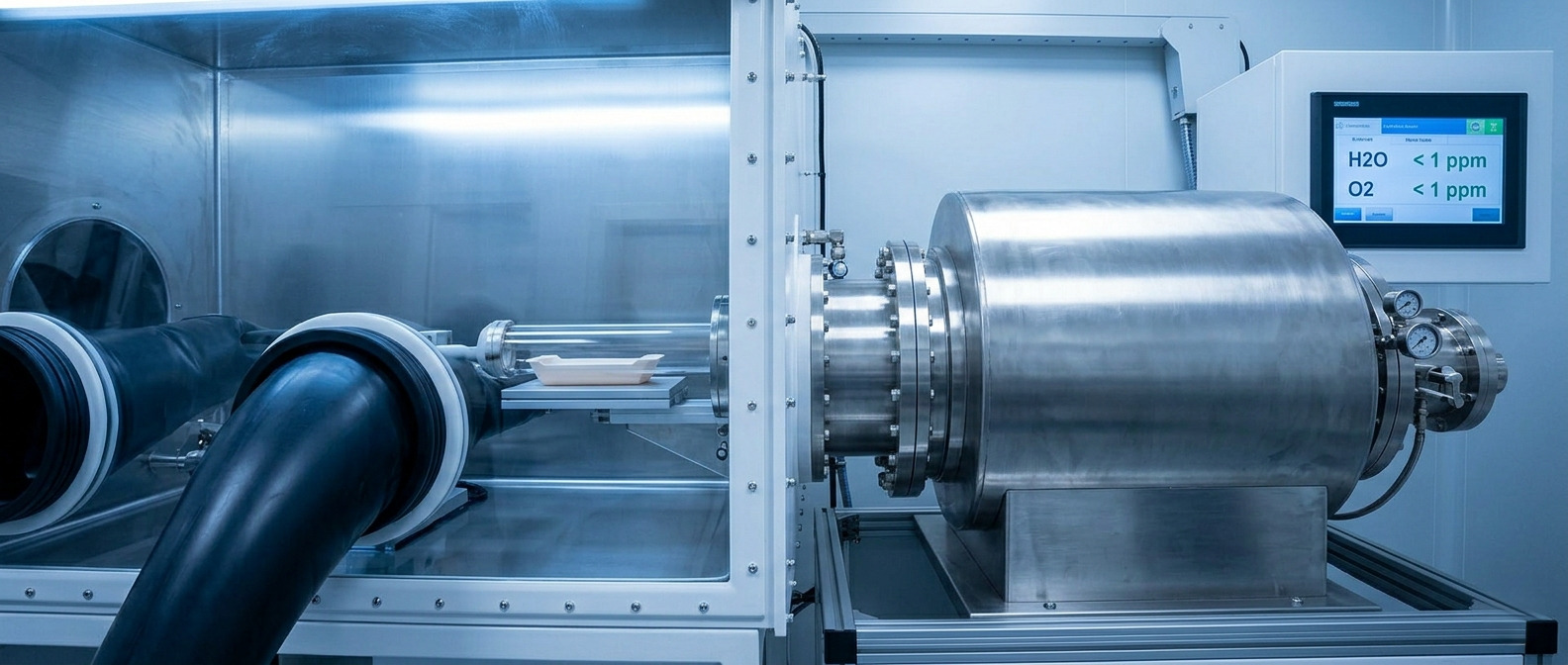
The integration of a vacuum tube furnace with an inert atmosphere glove box is a sophisticated engineering solution designed for the synthesis and processing of materials that are sensitive to oxygen or moisture, such as lithium-ion battery electrodes, perovskite solar cells, or reactive rare-earth alloys.
System Architecture
The connection is primarily achieved through a side-mounted flange interface or a T-shaped transition chamber. The furnace tube (typically alumina or quartz) is aligned horizontally or vertically such that one end opens directly into the glove box environment.
Technical Implementation and Sealing
To maintain the integrity of the glove box atmosphere (<1ppm O2/H2O), the connection must be vacuum-tight.
- The Transition Flange: A custom stainless steel (SS316L) flange is used. It employs double-layered Viton O-rings with a cooling jacket. Because the furnace operates at high temperatures, heat conduction toward the glove box wall must be mitigated using water-cooled gaskets to prevent thermal damage to the glove box seals.
- Expansion Management: Since the furnace tube expands when heated, the connection must include a bellows expansion joint. Without this, the rigid connection would crack the ceramic tube or warp the glove box panel.
Operational Workflow
- Loading: The user prepares samples inside the glove box, placing them in a ceramic boat.
- Insertion: Using a magnetic slide loader or a long-reach tool, the boat is pushed into the center of the furnace hot zone without exposing the sample to ambient air.
- Isolation: A gate valve (vacuum-rated) is often placed between the furnace and the box. This allows the furnace to be evacuated to high vacuum (10-5 Torr) while the glove box remains at a slight positive pressure of nitrogen or argon.
Current Challenges and Safety
A major technical hurdle is thermal convection. When the furnace is at 1200℃, hot gas can flow back into the glove box. Engineers use heat shields (molybdenum or alumina baffles) inside the tube to block radiant heat. Safety interlocks are mandatory: if the glove box pressure fluctuates beyond limits, the furnace power is automatically cut to prevent gas expansion from rupturing the box.