
Introduction
Humanoid robots are on the threshold of transitioning from research laboratories to the mass consumer market. However, three persistent mountains—range, weight, and safety—remain the critical bottlenecks hindering their commercialization and widespread adoption. The limitations of traditional liquid lithium-ion batteries have caused the industry to pivot towards All-Solid-State Batteries (ASSBs). This is a revolution in materials science, but even more so in precision manufacturing. To truly unlock the potential of solid-state batteries and empower the “power heart” of humanoid robots, a crucial manufacturing environment optimization technology must be introduced: Glovebox Integrated Optimization.
I. The Core of the Power Revolution: Solid-State Batteries
Humanoid robots demand exceptionally high performance from their power systems: they must be both “lightweight” and “long-lasting” (ultra-high energy density), run “safely” alongside humans (inherent safety), and provide “instantaneous large current output” when burst power is required (exceptional high-rate performance). Solid-state batteries, by replacing the flammable liquid electrolyte with a solid electrolyte, align perfectly with these requirements (as shown in Figure 1, Panel 1).
- Ultra-High Energy Density: With the potential to reach 500 Wh/kg, this is the key to lightweighting and extended range.
- Inherent Safety: Non-flammable, eliminating safety concerns for robots entering households.
- High-Rate Discharge Performance (Explosive Power): Supports ultra-large instantaneous current output, unlocking complex and high-burst movements.
II. Manufacturing Bottlenecks: The Necessity of Glovebox Optimization
The superior performance of solid-state batteries depends heavily on the quality of their internal interfaces (as shown in Figure 1, Panel 2). The contact resistance of solid-solid interfaces, and the extreme sensitivity of solid electrolytes to moisture and oxygen, pose monumental manufacturing challenges.
In an open or poorly controlled environment, lithium metal anodes rapidly oxidize (causing capacity decay), and sulfide solid electrolytes generate highly toxic hydrogen sulfide gas. Therefore, the R&D and manufacturing of solid-state batteries must be conducted within strictly controlled environmental enclosures—Gloveboxes.
The depth of glovebox optimization directly dictates the quality and performance of the solid-state batteries, and consequently, the ceiling to which they can empower humanoid robots (as shown in Figure 1, Panels 2 and 3):
1. Environmental Foundation for Micron-Scale Interface Engineering
Interface engineering (ALD, In-situ Polymerization) aims to establish flawless solid-solid contact (Conformal interface growth) and suppress side reactions. Glovebox optimization goes beyond merely maintaining low moisture and oxygen levels (e.g., H₂O < 1 ppm, O₂ < 1 ppm); it involves ultra-precise, automated control and real-time monitoring of all environmental parameters. Only within an extremely pure and stable environment can the density of atomic-scale coatings (ALD Nano-coatings) and the integrity of in-situ solidification be guaranteed.
2. Environmental Integration of Advanced Manufacturing Processes
The evolution of manufacturing processes (dry coating, Roll-to-Roll R2R, intelligent manufacturing) is critical for reducing costs and increasing efficiency. The core of glovebox optimization lies in seamlessly integrating this advanced manufacturing equipment into the controlled environment (Glovebox Integration).
- Glovebox Optimization for Dry Process Coating (< 1 ppm O2): Dry electrode preparation involves powder mixing and coating, requiring precise control of particle flow and deposition within the controlled environment to prevent dust migration and environmental contamination.
- Roll-to-Roll (R2R) Glovebox Integration (Atmosphere-controlled R2R Membrane Casting): Integrating large-scale rollers and membrane casting equipment into a glovebox is a complex engineering challenge, necessitating optimization of the internal space layout, gas dynamics, and mechanical transmission systems to ensure continuous, high-quality manufacturing of large-area, thin solid electrolyte membranes.
- Automation and AI Integration (FULLY-AUTOMATED GLOVEBOX INDUSTRIAL LINES): Industrial scale-up (as shown in Figure 1 roadmap, 2030+) requires fully automated glovebox production lines. By integrating robotic arms (visible in the central section of Figure 1) and utilizing AI-optimized interfaces (Micron-precision interface control), micron-level operational precision is achieved, minimizing human interference and environmental contamination.
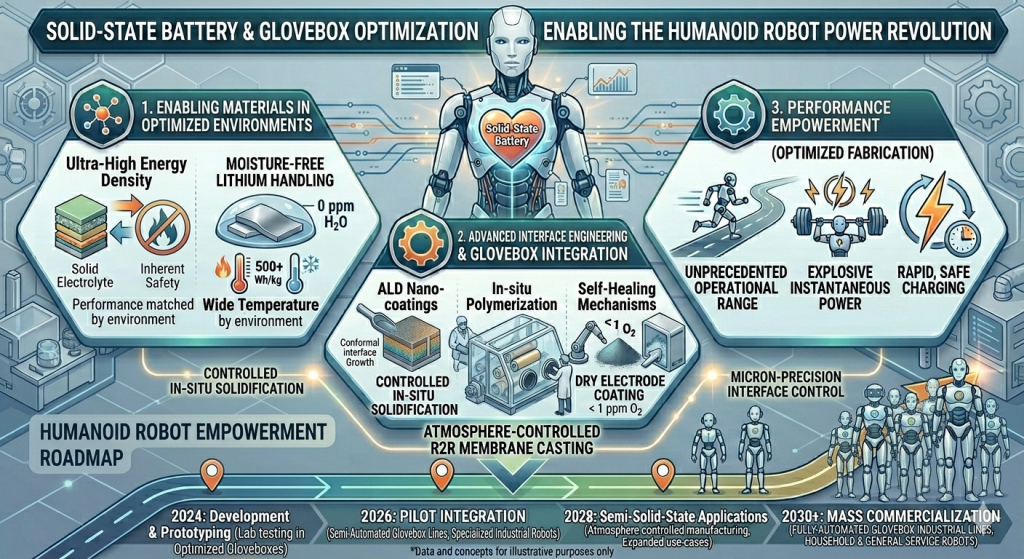
Figure 1: Infographic of Solid-State Batteries and Glovebox Optimization Empowering the Humanoid Robot Power Revolution
Figure 1 illustrates the three key levels of this technological empowerment:
1. Empowerment by Materials Technology: Foundation Laid in Controlled Environments
The core of solid-state batteries lies in breakthroughs in electrolyte materials (sulfides, oxides, polymers, etc.). Through material hybridization and gradient architecture design, these materials improve ionic conductivity and interfacial stability, laying the foundation for ultra-high energy density and burst power. However, these sensitive materials must be processed within an optimized Glovebox Handling environment (e.g., Moisture < 1 ppm) to maintain their electrochemical performance (the 2024 roadmap marker at the bottom shows lab testing already utilizing optimized gloveboxes).
2. Empowerment by Manufacturing Processes: Breakthroughs via Glovebox Integration
The industrialization of solid-state batteries requires breaking through traditional manufacturing process bottlenecks.
- Interface Engineering: ALD, In-situ Polymerization, and Self-Healing Mechanisms aim to reduce interfacial contact resistance. These processes are extremely environmentally sensitive and must be completed within a fully controlled and optimized glovebox (the central section of Figure 1, ‘FULLY-AUTOMATED GLOVEBOX INDUSTRIAL LINES’, shows its close connection to the interfaces).
- Advanced Manufacturing: Dry Process Electrode, Roll-to-Roll (R2R), and Intelligent Manufacturing are key to cost reduction and efficiency. Glovebox optimization requires the seamless integration of this advanced manufacturing equipment (as shown in the central section of Figure 1), utilizing automation and AI technology to ensure micron-level operational precision and batch-to-batch consistency.
3. Empowerment by Performance Metrics: Unlocking Final Product Capabilities
The comprehensive upgrade of materials and manufacturing (within optimized glovebox environments) ultimately translates into a massive leap in humanoid robot performance:
- Unprecedented Operational Range: Robots can perform long-distance movements or provide extended services.
- Explosive Instantaneous Power: Robots can easily perform high-burst movements like jumping and lifting heavy loads.
- Rapid, Safe Charging: Robot downtime is significantly reduced, increasing work efficiency.
III. Outlook: Evolution of the Power Revolution and Manufacturing Environments
The bottom of Figure 1 displays the roadmap for the power revolution. Starting from laboratory R&D in 2024 (Glovebox lab testing), moving through pilot lines in 2026 (Semi-Automated Glovebox lines), and culminating in 2030+ with fully automated industrial glovebox production lines (FULLY-AUTOMATED GLOVEBOX INDUSTRIAL LINES), the maturation of ASSB technology, along with interface engineering, self-healing mechanisms, and high-rate performance, will see its widespread application in the high-performance humanoid robot market (Household & General Service Robots).
Conclusion
Solid-state battery technology is like an “ideal heart” currently building up energy, and glovebox optimization is the crucial manufacturing tool that ensures this heart can “beat.” Through the comprehensive empowerment of materials, processes, and controlled environment optimization, the power revolution will completely unlock the potential of humanoid robots, ushering in an era of safer, more flexible, and more durable humanoid robots that will reshape human life and production methods.