
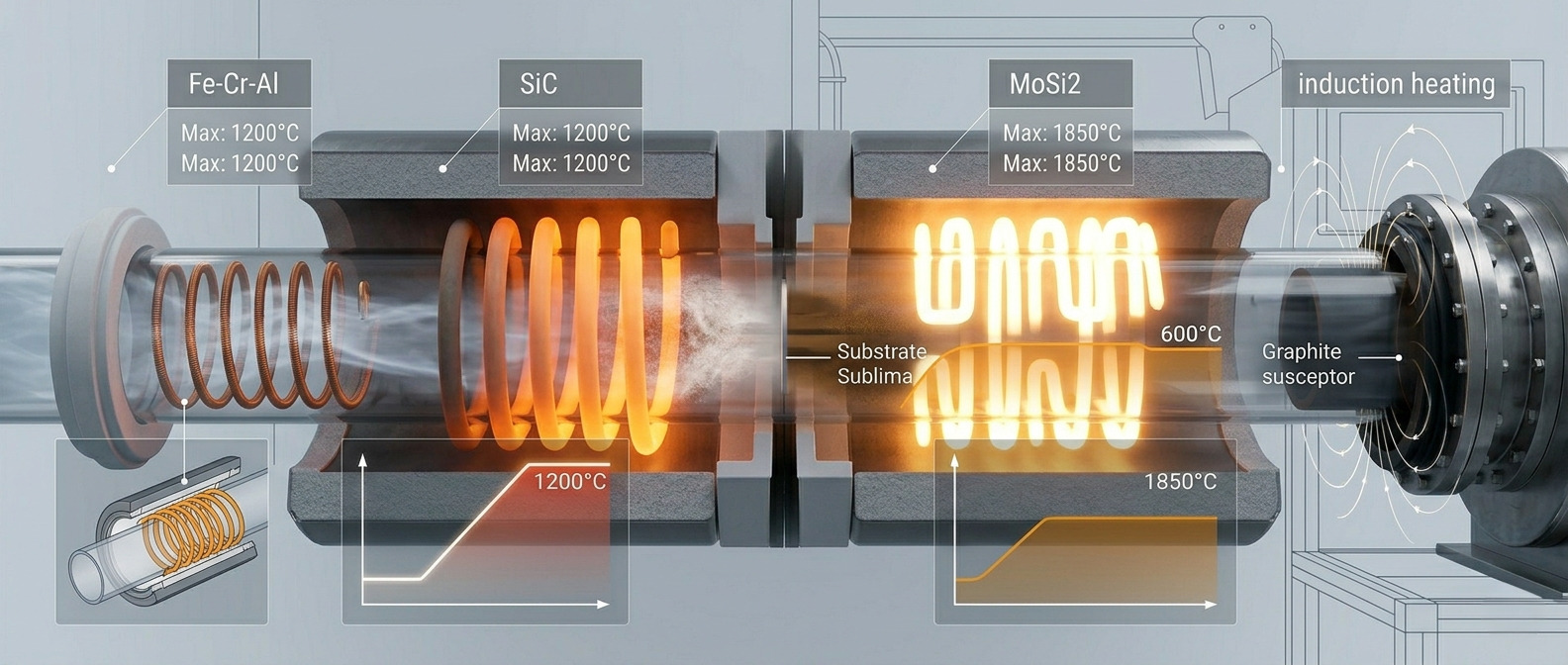
The heating system converts electrical energy into thermal energy and determines the maximum operating temperature and longevity of the furnace.
Heating Element Categories
- Resistance Wire (Fe-Cr-Al): Used for temperatures up to 1200℃. These are cost-effective but can sag over time.
- Silicon Carbide (SiC): Used for 1300℃ – 1500℃. These are robust but their resistance increases with age (“aging effect”), requiring a voltage-adjustable transformer to maintain power.
- Molybdenum Disilicide (MoSi2): The gold standard for 1600℃ – 1850℃. These elements form a protective quartz glass coating when heated. However, they are brittle at room temperature and cannot be used in a vacuum without specific modifications, as the protective layer will sublime.
Heating Geometry and Uniformity
To ensure a large “constant temperature zone,” heating elements are often densely coiled at the ends of the furnace and sparsely placed in the center. This compensates for the natural heat loss at the tube ends (the “End Effect”).
Future Tech: Induction and Microwave Heating
- Induction Heating (State-of-the-Art): Instead of resistance, an electromagnetic field heats a graphite susceptor. This allows for incredibly fast ramp rates (>100℃ /min), which current resistance-based tube furnaces cannot achieve without cracking the ceramic tube.
- Microwave-Assisted Heating: A theoretical/emerging technology where microwaves directly excite the material. While difficult to control in a tube format, it offers volumetric heating that could theoretically reach ± 0.5℃ uniformity.