
In the rapid evolution of Additive Manufacturing (AM)—commonly known as 3D printing—the focus has shifted from “what” we can build to “how perfectly” we can build it. As we reach the midpoint of 2026, the industry has moved far beyond rapid prototyping. We are now in the era of mass-producing critical aerospace turbines, medical implants, and high-performance automotive parts.
The secret weapon behind this transition isn’t just the lasers; it’s the Glove Box Integrated Atmosphere Control.
The Invisible Enemy: Oxidation and Porosity
When working with reactive metals like Titanium (Ti6Al4V), Aluminum-Lithium, or Nickel-based superalloys, the ambient air is a poison. Even at room temperature, these metals attract oxygen; at the melting temperatures required for laser powder bed fusion (LPBF), they oxidize instantly.
Oxidation leads to:
- Brittleness: Creating parts that fail under stress.
- Porosity: Microscopic bubbles that ruin the structural integrity of a component.
- Spatter: Irregular melting that destroys the precision of complex lattice structures.
2026: The Gold Standard of Purity
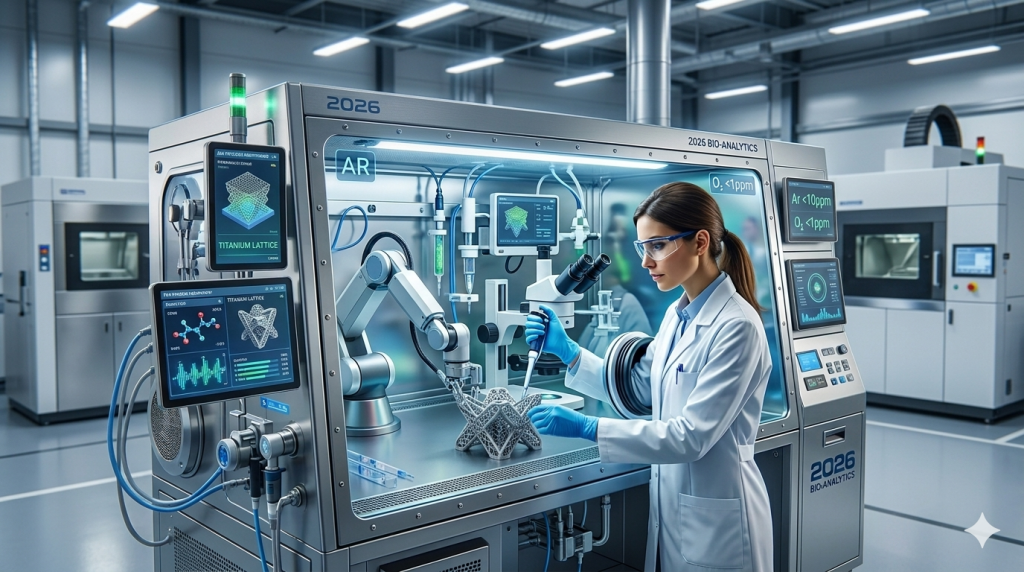
Today’s state-of-the-art additive manufacturing stations are no longer standalone printers. They are fully enclosed Inert Atmosphere Workstations. Modern glove boxes now maintain oxygen and moisture levels at less than 1 part per million (ppm).
By flooding the chamber with high-purity Argon or Nitrogen, the glove box creates a “vacuum-like” purity without the mechanical stress of a true vacuum. This allows the laser to melt the metal powder in a chemically neutral state, ensuring that the final part has the same mechanical properties as a forged piece of metal.
Beyond the Build: Powder Management
The role of the glove box extends before and after the laser starts firing. In 2026, Closed-Loop Powder Handling is the industry standard.
- Sieving & Loading: Metal powder is loaded and sieved inside the glove box to prevent “moisture pick-up” from the room’s humidity.
- Post-Processing: Once a build is complete, “de-powdering” (removing the excess powder from the printed part) occurs within the same inert environment. This prevents the unused powder from degrading, allowing for a 99% recycle rate—drastically reducing the cost of expensive aerospace alloys.
Automation and Safety
Safety is the silent beneficiary of this technology. Fine metal powders are not only a respiratory hazard but can be highly explosive (combustible dust). The integrated glove box acts as a secondary containment shield, protecting the facility from fire risks and protecting the technicians from inhaling nano-scale metallic particles.
With the integration of AI-driven sensors, these systems now automatically adjust gas flow based on real-time melt-pool monitoring, ensuring that the atmosphere remains perfect from the first layer to the ten-thousandth.
Conclusion: The Future is Sealed
As we look toward the future of space exploration and sustainable aviation, the demand for lighter, stronger parts will only grow. The glove box has evolved from a simple laboratory tool into a critical industrial component—the “invisible laboratory” where the high-strength world of tomorrow is printed today.