
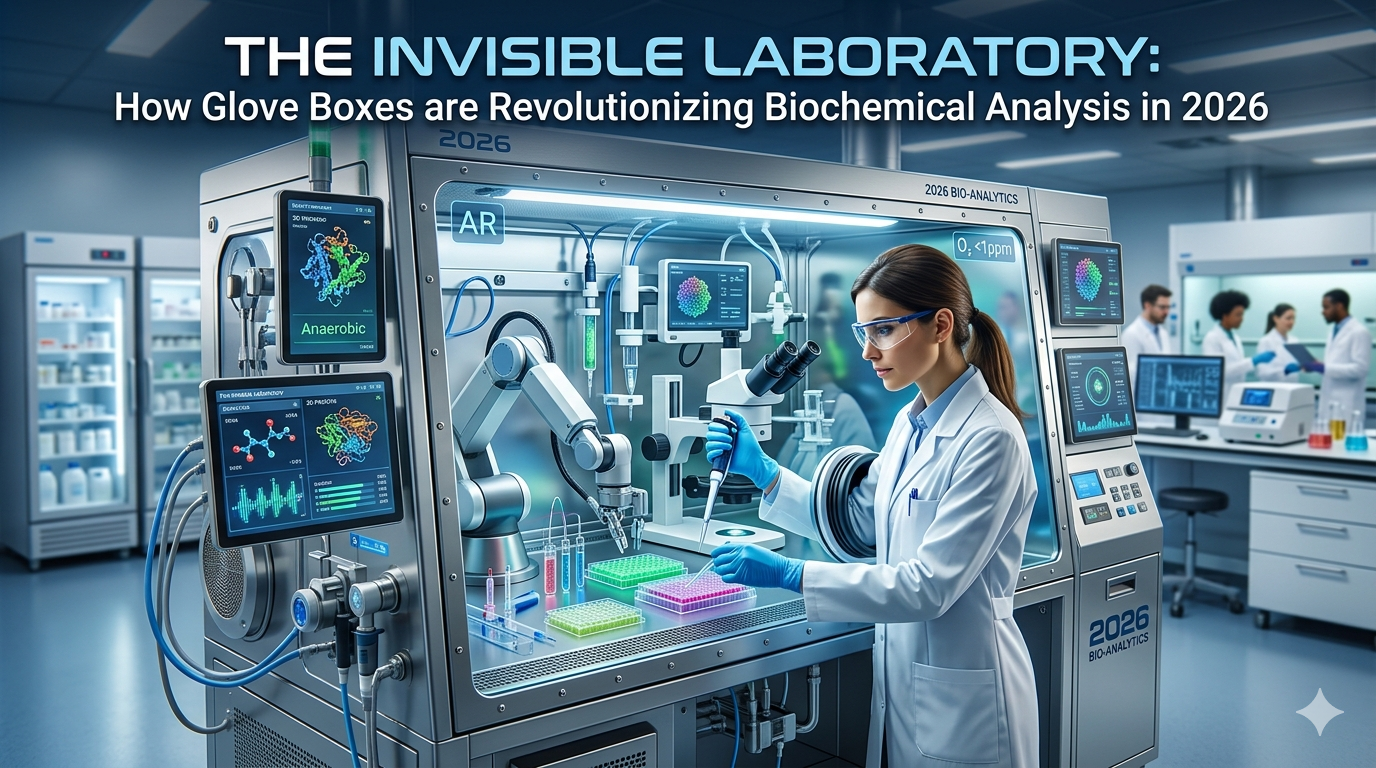
In the landscape of modern biotechnology, the boundary between “clean” and “contaminated” has never been thinner. As we push the limits of synthetic biology, proteomics, and personalized medicine, the equipment that facilitates these breakthroughs must evolve. Enter the Modern Glove Box—no longer just a sealed steel box, but a sophisticated, integrated “micro-factory” that has become the unsung hero of the biochemical sector.
Here is how glove box technology is currently redefining biochemical analysis and research.
1. The Pursuit of “Absolute Zero” (Anaerobic & Sterile Environments)
Many biochemical reactions—particularly those involving the human microbiome or oxygen-sensitive enzymes—require environments that mimic the inside of the human gut or deep-sea hydrothermal vents.
Today’s glove boxes utilize advanced gas purification systems that can maintain oxygen and moisture levels at sub-1 ppm (part per million). For researchers analyzing anaerobic bacteria, this ensures that the delicate biological pathways remain intact from sampling to sequencing.
2. Integration of Real-Time Analytics
Gone are the days when a glove box was simply a storage or prep station. In 2026, we are seeing the rise of In-Situ Analytical Workstations.
- Integrated Microscopy: High-resolution live-cell imaging is now performed inside the inert atmosphere, allowing scientists to observe biochemical processes in real-time without ever exposing the sample to ambient air.
- Mass Spectrometry Links: Modern systems often feature direct-coupling ports to Mass Spectrometers or HPLC (High-Performance Liquid Chromatography) units, ensuring the “chain of custody” for sensitive biochemical samples remains unbroken.
3. The Shield Against “Next-Gen” Pathogens
With the rise of gain-of-function research and the synthesis of novel viral vectors in pharmaceutical R&D, Personal Protection and Sample Integrity are paramount.
Modern biochemical glove boxes often operate under negative pressure for bio-containment (BSL-3 and BSL-4 applications). This dual-functionality protects the scientist from hazardous biological agents while simultaneously protecting the sample from external DNA/RNA contamination that could ruin sensitive PCR or CRISPR-based analysis.
4. Automation and the “Glove-less” Future
Perhaps the most significant shift in 2026 is the integration of Robotics and AI. Manual handling through thick rubber sleeves is prone to human error and physical fatigue.
Biochemical labs are increasingly adopting Automated Glove Boxes equipped with internal six-axis robotic arms. These systems can:
- Perform high-throughput pipetting.
- Manage bio-bank storage.
- Execute complex reagent mixing with a degree of precision (microliter scale) that human hands cannot match.
Why It Matters: The Future of Drug Discovery
The precision offered by these enclosures is a primary driver behind the accelerated pace of drug discovery. When we analyze how a new protein-based drug interacts with a cell, the smallest variable—a 1% shift in humidity or a trace amount of oxygen—can lead to false positives.
By providing a physiologically relevant environment, the modern glove box ensures that the data we collect in the lab translates accurately to the human body.
Conclusion
The glove box has transformed from a passive barrier into an active participant in biochemical discovery. As we look further into the decade, the convergence of digital twin technology (where the glove box environment is monitored and simulated via AI) and modular automation will continue to make these systems the gold standard for anyone serious about high-stakes biochemical analysis.
Are you working with oxygen-sensitive proteins or anaerobic cultures? What’s the biggest challenge you face in maintaining sample integrity?