
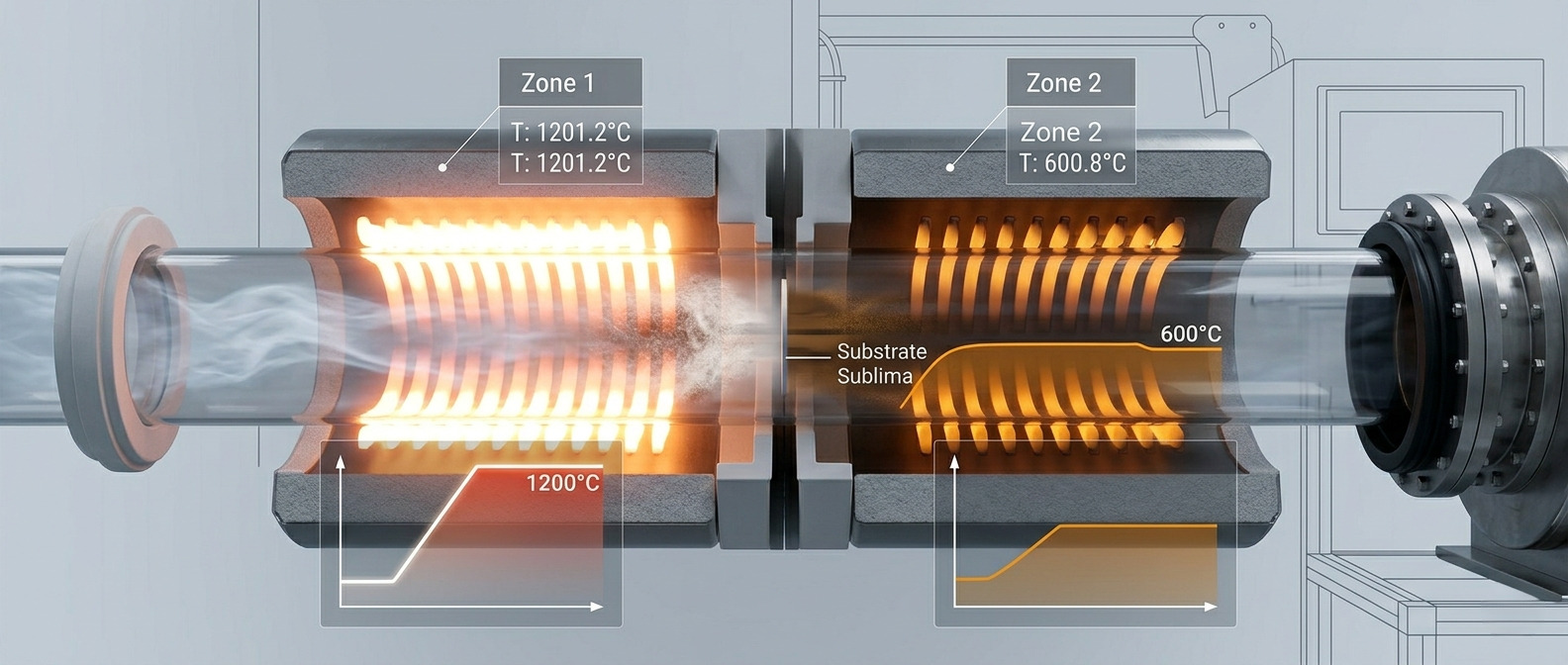
Dual-zone tube furnaces are essential for Chemical Vapor Deposition (CVD) and physical vapor transport (PVT), where one zone sublimes a precursor and the second zone facilitates deposition at a different temperature.
Structural Design
A dual-zone furnace contains two independent sets of heating elements and thermocouples within a single outer shell. These zones are separated by a thermal bridge or a high-efficiency ceramic fiber insulator to minimize thermal crosstalk (interference between zones).
Temperature Gradient Control
The primary technical challenge is maintaining a sharp temperature gradient between zones.
- Zone Isolation: High-density polycrystalline alumina fibers are used as bulkheads.
- Power Management: Each zone is governed by an independent PID controller. If Zone A is at 1000℃ and Zone B is at 600℃, Zone B requires significantly less power because it receives “parasitic heat” from Zone A. Advanced controllers use “Feed-Forward” logic to compensate for this.
Applications in Material Synthesis
In 2D material growth (like Graphene or MoS2), the dual-zone setup allows for:
- Independent Precursor Control: Evaporating sulfur at 200℃ while the substrate is at 800℃.
- Annealing Profiles: Creating a controlled cooling slope that is impossible in a single-zone system.