
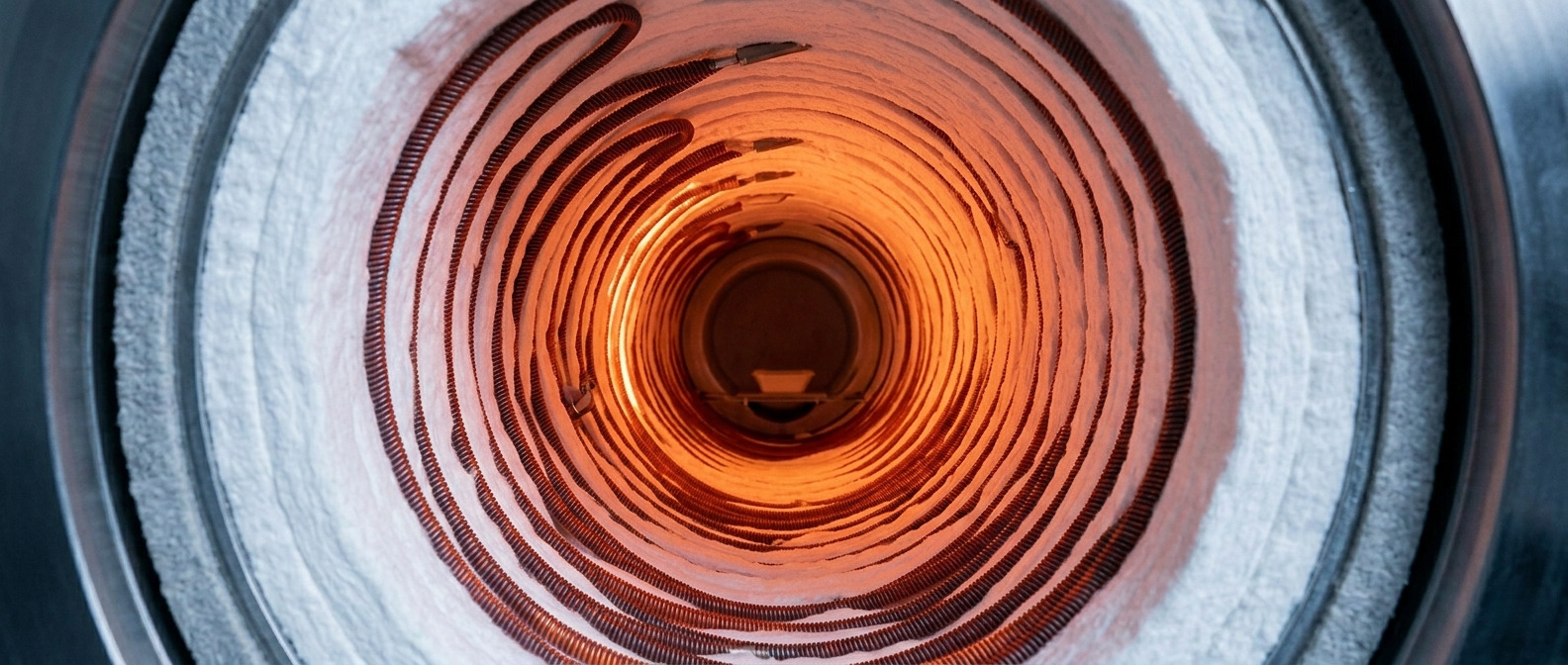
The “hearth” or chamber is the heart of the furnace, responsible for thermal insulation and structural support for the heating elements.
Materials and Composition
Modern furnace chambers have moved away from heavy refractory bricks to Vacuum Formed Ceramic Fiber (VFCF).
- Inner Lining: Usually consists of high-purity alumina fibers (Al2O3 > 99%) which can withstand up to 1800℃.
- Backing Layers: Lower-density fibers are used for the outer layers to minimize thermal mass, allowing for faster ramp rates and energy efficiency.
Structural Engineering: The “Dual-Shell” Design
Modern chambers are housed in a dual-shell stainless steel casing with fan-assisted air cooling. This ensures that while the internal chamber is at 1600℃, the outer surface remains safe to touch (<45℃).
Technical Limitations
While current fibers are excellent insulators, they are susceptible to chemical attack from corrosive vapors (e.g., fluorides or strong acids). In such cases, the hearth must be coated with a protective zirconia layer or the tube itself must be the primary barrier, with the chamber remaining under a clean air environment.